
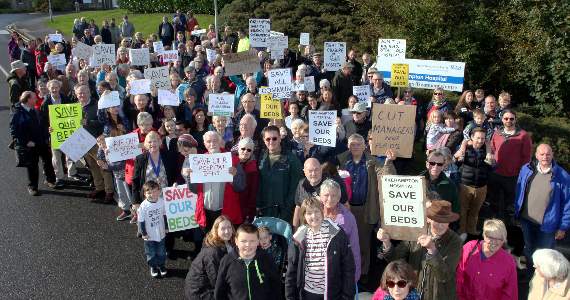
ALMOST 200 people turned out on Saturday morning to protest the proposed cut of Okehampton Hospital’s 16 in-patient beds.
Dozens of people turned up to the hospital to protest Northern, Eastern and Western Devon Clinical Commissioning Group’s (NEW Devon CCG) decision to launch a consultation on cutting half of the community hospital in-patient beds across its eastern locality.
The current 143 beds across the locality’s hospitals are to be reduced to 72 beds located at three hospitals instead of the seven used at present.
The CCG is considering four options which would keep beds at Tiverton Hospital and two other hospitals out of Sidmouth, Exmouth, Seaton or Whipton. All four options mean Okehampton Hospital would lose all its in-patient beds.

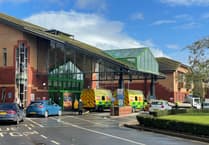

The plans have caused outrage in Okehampton. That was especially evident during Saturday morning’s protest, where dozens of people turned out to object to the consultation proposals.
Cllr the Rev Mike Davies organised the protest and is running the ’Save Our Beds — Okehampton Hospital’ Facebook page. He said: ’The Okehampton Hospital protest went well. I had a couple of people try and count the number of attendees and it is believed there was just under 200.
’Our next protest will be at the CCG meeting at County Hall in Exeter in November.’
Cllr Jan Goffey, Okehampton Mayor, said: ’Thank you to all of the 200 or so wonderful people who turned out on Saturday morning in the wind and the rain —some of the time — to protest the loss of Okehampton Hospital’s in-patient beds.
’I heard even more stories of the elderly parents, neighbours and others who received wonderful care there and if they’d been in Tiverton, Sidmouth, Holsworthy or further afield, family would not have been able to visit.?’This is too valuable a community asset to lose, not just for Okehampton but for all those villages who supported us this morning; Okehampton Hamlets, Belstone, South Zeal, Sticklepath, Winkleigh, Hatherleigh, Bratton Clovelly, Broadwood, Chagford, Drewsteignton, Exbourne and Jacobstowe and no doubt even smaller places in between.
’This is not just for Okehampton but for the 20,000 people for whom Okehampton is the hub. Thank you Mike Davies for organising this protest and all the town, borough, county and parish councillors who came and supported us.’
Mel Stride, MP for Central Devon, said: ’I am very disappointed that the CCG is consulting on options all of which exclude the possible retention of Okehampton Hospital’s in-patient beds. I have already discussed my concerns with the CCG chief executive and have written to her to ask for a full explanation of the reasoning behind this decision. I will shortly be holding further meetings with local stakeholders and will be fighting very hard on this issue — the current situation is simply not right.’
In the NEW Devon area, local health and social care organisations are facing a financial shortfall in 2015/16 of £122-million, which will rise to £384-million in 2020/21 if nothing changes.
The CCG argues that at the same time, many people are in hospital beds who could be cared for at home. They say that with the right care, people can be supported to be in their own home, and this is their goal.
In order to deliver this model of care where more people receive proactive support in their own homes, avoiding hospital admissions and getting home from hospital sooner, the CCG needs to increase the number of staff in the community teams.
To achieve this it needs to take the skills, expertise and resources from delivering inpatient care to delivering care in people’s homes.
The model has three key aspects to it:
A comprehensive assessment – this identifies people who are frail or becoming frail, and therefore are at risk of being admitted to hospital, and puts a care plan in place for them which sets out possible routes for escalating care when needed.
Single point of access – when additional support is needed, a single point of access, connected to a comprehensive care at home service, will help people to remain at home with support, rather than being admitted to hospital.
Rapid response (care at home) – when someone does need to go to hospital they will be helped to leave as soon as it is clinically safe to do so, with additional support provided at home including health and care workers delivering rehabilitation alongside traditional care.
Comments
This article has no comments yet. Be the first to leave a comment.