
The day looked promising for the walkers who set out to enjoy a walk of almost ten miles.
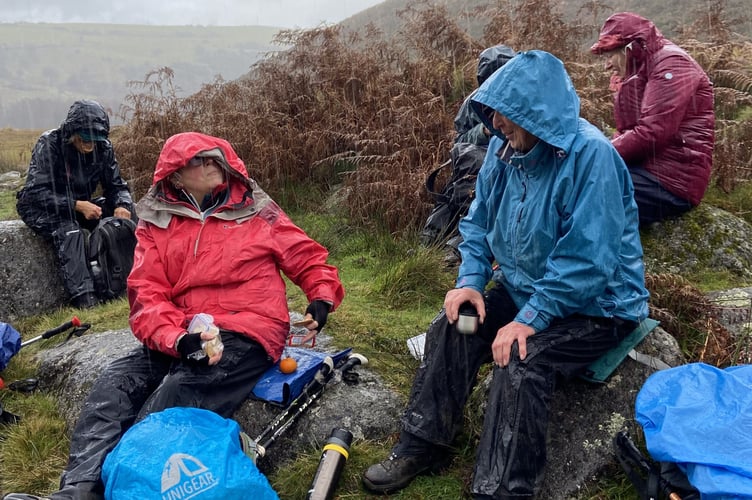
The sun emerged briefly and there was hardly any wind. The rain held off until the lunch stop at Vellake Corner where the nine remaining walkers got drenched, and having just dried out, they got another soaking on the last mile or so of the walk.
Spectacular views were enjoyed along the way especially of the water cascading over Meldon Dam. As anticipated, the ground was mostly sodden and very slippery underfoot. First settled in the Bronze Age, Okehampton really developed in the Saxon period as a settlement on the River Okement. It was first mentioned in 980 AD as Ocmundtune.




By 1086 the name had evolved and was recorded in the Domesday Book as Ochementone.
Before long, the name changed again and it became Okehampton, ‘a place where slaves were freed from crossroads’. The town grew on the medieval wool trade and was well-known for its white cloth (serge).
In 1840, the town had the highest number of looms in the country. There were still four operating mills in the town well into the 1900s.
Okehampton was a popular staging post for coach traffic between London and Cornwall from 1760 to 1860 with the establishment of The London Inn, the White Hart Inn and The Plume of Feathers.
The railway first came to the town in 1871. During World War II the Polish Navy in exile came to Britain and in 1944 the Polish Naval Warrant Officer School moved here from Devonport occupying land on the Oaklands Estate where the rugby club is now, which had previously been occupied by the American military.
The Women’s Naval Auxiliary Service was also located at the camp. The camp was named after the Polish ship ORP Bałtyk and jokingly referred to as a “Stone Frigate”. The officer’s mess was known as ‘The Lost Weekend’.
Leaving the post office via the Tarka Trail along Castle Road, the group was soon climbing up through the woods and heading towards Meldon Dam along the Two Castles Trail/West Devon Way.
Surrounded by steep sided banks and approximately 900 feet above sea level, Meldon Reservoir offers some of the most breathtaking scenery on North Dartmoor. The 19th century disused viaduct which carried the railway across the West Okement River is a truss bridge constructed from wrought iron. A truss bridge is one whose load-bearing superstructure is composed of a structure of connected elements, usually forming triangular units and is used because it is a very rigid structure and it transfers the load from a single point to a much wider area. Truss bridges are not used anymore because they are costly and tedious to build and maintain. The viaduct opened in 1874 for a single track and in 1879 its width was doubled for a second track. The viaduct, a scheduled monument, is now used by the Granite Way, a leisure route skirting Dartmoor, and is one of only two surviving railway bridges in the United Kingdom that use wrought iron lattice piers to support wrought iron trusses.
The walkers followed the single-track path around the reservoir to Vellake Corner – where the heavens opened just as they opened their packed lunch boxes! It was a very short lunch break! The crossing is a good link between the western side of Dartmoor and Yes Tor and High Willhays, the highest points on the moor.
After long periods of heavy rain, the land to the east of the crossing point can become flooded making the crossing impossible.
On their return the group passed by Meldon Woods, which are owned and managed by the local council and fall within Dartmoor National Park. Even without the abundance of bluebells found here in the spring, or the huge variety of fungi found in the autumn, it is always a delightful stretch of ancient woodland to enjoy but on this occasion the walkers decided to avoid the steep slippery woodland descent and walked on the road below.
They returned via fields to cross the golf course again before making their way back down through the town park.
The club stages a ramble every Sunday and as ever new walkers are always welcome.
Meet at the post office in George Street, Okehampton on Sunday mornings ready to leave at 9.30am. Please be there in plenty of time so that the group can leave promptly. Next week the walk will start at Lowery Cross. Where possible, we try to share cars though this cannot be guaranteed.
You should be suitably attired for all weather conditions, including sturdy footwear and bring a packed lunch.
Comments
This article has no comments yet. Be the first to leave a comment.