

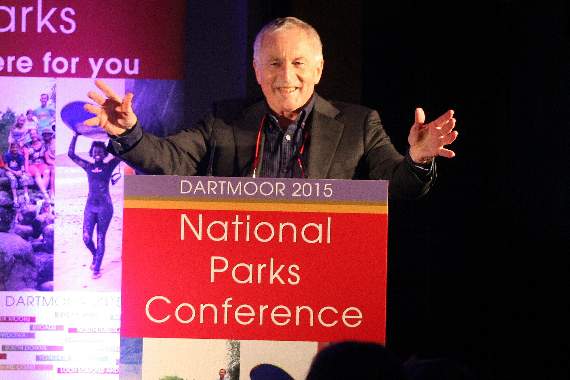
DARTMOOR National Park played host to the biennial UK National Parks Conference last week, for a gathering that is likely to have a monumental impact on the future of national parks.
Every two years, the 15 UK national parks hold a conference that provides an opportunity to consider the value of the parks, their current challenges and opportunities and options to sustain the parks for future generations.
This year’s meeting comes as government funding to national parks faces significant cuts – threatening many authorities’ ability to operate.
Hearing from industry specialists, MPs and journalists, the future challenges of the iconic landscapes were discussed in depth over the three days at Bovey Castle.


The first day was opened with a video message recorded by the Prince of Wales, who supports rural communities through his charities across the UK.
As Duke of Cornwall, the prince has a special affinity with Dartmoor. The Duchy of Cornwall has been the largest land owner since the 14th century and has worked closely with the national park for more than six decades.
In his address, he said: ‘We have a duty to look after these special places.
‘At a time when society has many pressing concerns, national parks have a crucial part to play.’
Delegates also heard from Trevor Sandwith, from the International Union for the Conservation of Nature, the world’s oldest and largest global environmental organ-isation.
He spoke about how UK national parks sit within the global family of national parks. Mr Sandwith also discussed the unique qualities national parks share, balanced against future challenges such as increasing populations and dwindling resources.
Other speakers took the opportunity to hold the national parks’ own authorities accountable for negative changes made to the parks over recent years.
George Monbiot, Guardian columnist, author and environmentalist, who has previously described the Lake District as ‘sheep-wrecked’, due to over grazing by sheep, said during his address that ‘National parks are scarcely better for wildlife than multi storey car parks.
‘National parks would be better designated as ecological disaster zones. We only have “category five” areas which are bad for wildlife but bad for human life as well.’
In his talk, named ‘Time to go wild’, George discussed ‘rewilding’ – a large-scale conservation aimed at restoring and protecting natural processes and core wilderness areas, providing connectivity between such areas, and protecting or reintroducing apex predators and keystone species.
He said: ‘National park authorities see that there are conflicts but need to allow us to see that there are conflicts.
‘National parks should be changing the way we see the land, they should be in the forefront of changing the land.’
George urged national park representatives to return to their roots and reintroduce different varieties of trees and species of predators such as wolves.
The conference continued with a ‘National Parks – Any Questions’ debate, chaired by Jonathan Dimbleby.
Panellists included: George Monbiot; Ross Murray, deputy president of the Country Landowners’ Association; Kate Ashbrook, general secretary of the Open Spaces Society; and Adrian Phillips, former director general of the Countryside Commission.
Also included in the panel was TV presenter, naturalist and local home owner, Nick Baker.
Basing most of his answers on his own experiences of living in Chagford, Nick said his favourite things about Dartmoor are the narrow windy lanes and hedgerows and that ‘Dartmoor is in its own little bubble of biodiversity.’
He also discussed his fears for the future of housing in his local area, saying that the younger people living there now will not be the ones able to afford the houses currently being built.
He added: ‘The area is becoming urbanised with the houses going up.’
Later in the debate, George Mombiot revisited the topic of ‘rewilding’ saying that he wanted more people to visit the countryside and that could be achieved if the parks’ authorities introduced some more predators.
He added: ‘Nothing would be better than filling the environment with some predators.’
Nick Baker added: ‘(with predators) You have to be aware of what’s around you and listen out for twigs snapping. The excitement and respect has gone because of that.’
The debate was concluded with each of the panellists being asked what they would like to see in national parks in the future. George Monbiot didn’t surprise anyone when he said ‘I’d like to see them go as wild as possible!.’
On the second day of the conference, visitors were able to explore the land during themed study tours.
Drawing the conference to a close was Sir Jonathon Porritt, founding director of Forum for the Future, who discussed ‘Nature Capitalism.’
Forum for the Future is the UK’s leading sustainable development charity with a growing presence in the United States, India, Hong Kong, Singapore and Malaysia.
Jonathan was formerly director of Friends of the Earth, co-chair of the Green Party and as Chairman of the UK Sustainable Development Commission until 2009, he spent nine years providing high-level advice to Government Ministers.
Peter Harper, Chairman of Dartmoor National Park Authority said: ‘We are responsible for the future of the UK’s finest landscapes and the communities that live within them.
‘I hope this conference has challenged our thinking and stimulated debate, both formally and informally, giving us all a renewed sense of vigour and vision to help manage the UK’s finest landscapes for the benefit of everyone, now and tomorrow.’
Chief executive at the Campaign for National Parks, Fiona Howie said: ‘Hosting the biennial UK National Parks Conference was a wonderful opportunity for Dartmoor to showcase itself to the rest of the national parks family – and they did themselves proud.
‘Delegates were challenged by all of the speakers.
‘Our national parks face difficult times in terms of future funding. But everyone who cares about them needs to look to the future and make sure these amazing landscapes continue to be loved, valued and enjoyed by future generations. How that will be achieved will be exciting to see!’
Comments
This article has no comments yet. Be the first to leave a comment.