
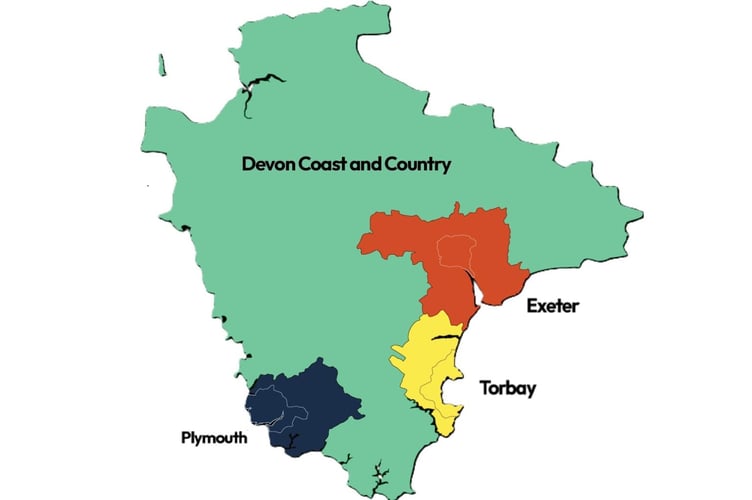
THE names of Devon’s four new councils have been confirmed with a stark cut in councillor numbers.
The four new unitary councils will be called Exeter Council, Torbay and South Devon, Greater Plymouth, and Devon Council.
These will be the legal names given to them as part of the local government reorganisation process, however, once established, councils can apply to change their names.
A huge reduction in the number of councillors across these four councils looks set to take place, though, with the existing total of 481 members across Devon’s 11 councils dropping to 321.
That’s a fall of about a third and could have an impact on the size of the wards elected members will have to cover.
The letter suggests the government wishes to push on with the creation of the new councils in spite of the threat of a judicial review by Devon County Council.
The new councils are set to launch by April 2028, and will be responsible for all the services within their respective boundaries.
This will be a different model to the existing two-tier one that exists for most Devon residents, whereby Devon County Council oversees the likes of highways and education, but district councils collect waste and decide planning applications. Both Plymouth City Council and Torbay Council are already unitary.
Devon Council, which will be a vast, predominantly coastal and rural authority, will have the most councillors at 103, with Exeter Council the next largest at 86, followed by 68 for Greater Plymouth and 64 for Torbay and South Hams.
A letter from the government to the chief executives of all existing councils, outlines a wish for joint committees to be created to help set up the new councils.



The Devon Council will have seven members from across the district areas and another seven from the county council, giving it the biggest joint committee.
Two people from Exeter City Council, and one from each of the three districts that will partly help create the new Exeter Council will join five county council representatives for a total of a 10-strong joint committee.
Similar arrangements will take place for the Torbay and South Devon Council and Greater Plymouth.
The government has confirmed £900,000 of funding per new unitary – meaning a total of £3,600,000 for Devon – to support the formation of the new councils, while there could be an additional £150,000 per new unitary to help ease the changes in children’s and adult social care.
The letter demands further information from Devon’s councils by August 17 to help it create a Structural Change Order, which is the formal mechanism for creating new councils and will go through a full Parliamentary process.
“Once we have finalised the Order, we anticipate sharing this draft informally with legal advisors to the Parliamentary Joint Committee on Statutory Instruments, for informal scrutiny and feedback,” the government letter states.
“Following this informal scrutiny, we will be in a position to ask Ministers to formally lay the draft instrument before Parliament.
“It will then go through the Parliamentary process. This includes formal consideration by the Joint Committee on Statutory Instruments and the Secondary Legislation Scrutiny Committee for the House of Lords, a debate by a Committee of each House, and then, subject to their agreement, approval motions in each House.
“We anticipate that the Order will be made, and so come into force, in 2027.”
Elections are set to be held for the new councils in May 2027, but the councils won’t fully take over from the existing ones until April 2028.
Comments
This article has no comments yet. Be the first to leave a comment.