
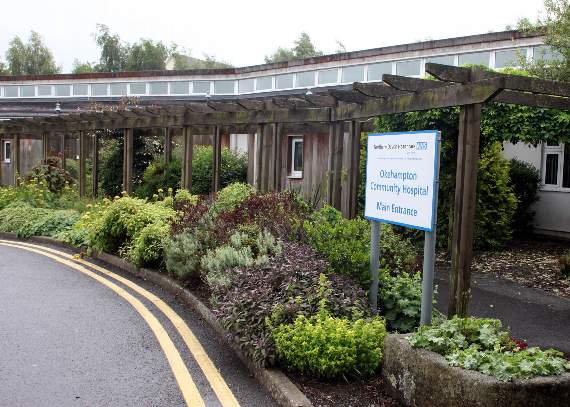
PLANS by the Northern, Eastern and Western Devon Clinical Commissioning Group (NEW Devon CCG) to close all 16 in-patient beds at Okehampton Community Hospital, which have been described as ’outrageous’ and ’utter madness’.
On Wednesday, September 21 the NEW Devon CCG unveiled plans to cut half of the inpatient beds in their Eastern Locality, which includes all 16 beds in Okehampton. The current 143 beds across the locality’s hospitals are to be reduced to 72 beds located at three hospitals instead of the seven used at present.
The CCG is considering four options which would keep beds at Tiverton Hospital and two other hospitals out of Sidmouth, Exmouth, Seaton or Whipton.
These plans mean Okehampton Hospital would lose all its in-patient beds.


The chairman of the Friends of Okehampton Hospital, Martin Perry, said: ’This is outrageous when only a few weeks ago we were assured our hospital in Okehampton was secure and if anything under utilised. We assumed by this inpatient beds were to be retained.
’Our committee understand and accept the evidence that most patients recover more quickly in their home environment with a suitable package of care but some, of course, are too ill and poorly to cope. We also understand the financial pressures the NHS in Devon is under when a deficit of £384-million is predicted by 2020 and radical changes are inevitable.
’However, accepting all that, we find the options being put to the CCG board totally unacceptable. All of the four options would involve huge distances – round trips of up to 168 miles and three hours driving.
’For patients, carers and visiting family and friends this is utter madness. With no public transport from the rural villages this makes the proposals even more of a nightmare.
’Here in Okehampton we have a purpose-built, relatively new hospital with high scoring reviews by all the hospital inspectorate teams. The criteria used by the CCG in reaching these options were the quality of care, access, finance, ward configuration and the flexibility of the site – in all areas we believe Okehampton rates highly.
’Seaton, Sidmouth and Exmouth are all located quite closely together so it makes no sense to leave this large area of West Devon with no in-patient beds.
’The CCG told me today that this review concerned only the in-patient beds and the rest of the services provided from Okehampton Hospital such as the 41 clinics, have not been considered yet.
’A few weeks ago we were told that the minor injuries unit which was moved to the health centre would be moved back to the hospital once a consortium of medical practices could be put together to run it.
’In view of today’s news we are uncertain what to believe but may I suggest anyone concerned about these changes write to the CCG and reject the four options currently being considered. Dr Tim Burke, NHS NEW CCG, Newcourt House, Newcourt Drive, Old Rydon Lane, Exeter EX2 7JQ.’
Okehampton Mayor Cllr Jan Goffey said the move was ’absolutely appalling’.
She said: ’It seems the decision was made some time ago. The consultation period is for the CCG to talk to people and inform them and explain the decision, not to change it.
’With no in-patient beds in Okehampton, people will die. It’s as simple as that. I’m allergic to wasp stings — if I got stung in the neck I wouldn’t make it to Exeter or one of the other hospitals. Where are elderly people who need care going to go? It is absolutely appalling. It is the privatisation of medicine through the back door. It shouldn’t be happening.
’The NHS is hiring all sorts of highly-paid consultants to carry out these studies. What we need to be spending the money on is ground staff, our wards, our nurses. We need our hospitals.
’Okehampton Medical Centre has 14,400 patients enlisted. That is obviously not just from the town but Okehampton Hamlets, the villages and surrounding areas. It is vital to have our hospital. We’ve been given reassurances in the past about the minor injuries unit returning to the hospital and our wards being safe but it was all for nothing.’
In NEW Devon local health and social care organisations are facing a financial shortfall in 2015/16 of £122m, which will rise to £384m in 2020/21 if nothing changes. The CCG argues that at the same time, many people are in hospital beds who could be cared for at home. They say that with the right care, people can be supported to be in their own home, and this is their goal.In order to deliver this model of care where more people receive proactive support in their own homes, avoiding hospital admissions and getting home from hospital sooner, the CCG needs to increase the number of staff in the community teams. To achieve this it needs to take the skills, expertise and resources from delivering inpatient care to delivering care in people’s homes.The model has three key aspects to it:Comprehensive assessment – this identifies people who are frail or becoming frail, and therefore are at risk of being admitted to hospital, and puts a care plan in place for them which sets out possible routes for escalating care when needed.Single point of access – when additional support is needed, a single point of access, connected to a comprehensive care at home service, will help people to remain at home with support, rather than being admitted to hospital.Rapid response (care at home) – When someone does need to go to hospital they will be helped to leave as soon as it is clinically safe to do so, with additional support provided at home including health and care workers delivering rehabilitation alongside traditional care.
GP Dr David Jenner, chairman of the Eastern locality for the Clinical Commissioning Group, said the care provided by NHS staff in the area was among the best in the country but there were also challenges. He said: ’One of the biggest challenges for us is when out-dated models and a lack of co-ordination between services means we are not able to provide better care.’
’We know we can do more to support a faster return home and also prevent unnecessary hospital admissions. Bed-based care will always be available for people who need to be in a hospital but we need to make sure the alternative of home-based care is always considered.
’Too many people are currently in hospitals that don’t need to be there and they could be receiving a better service at home.’
Angela Pedder, former chief executive (CEO) of the Royal Devon and Exeter NHS Foundation trust and now lead CEO for programme, said difficult decisions lay ahead.
’At times when people are at their most vulnerable and most in need of support, our current system requires them to navigate their way through the multiple boundaries that exist between services.
’Our GPs and other clinical staff also described similar difficulties. This results in delays, multiple assessments and frequently the only care intervention available is an emergency referral to a hospital due to the lack of a more appropriate, easily accessible, alternative service.
’We recognise the changes we are proposing will prompt difficult debate but we firmly believe the options in the consultation represent a real opportunity for us to improve care.’
The governing body of the CCG will make a decision on whether the proposals will go out to public consultation on September 28. If approved, public consultation on the plans will run over 13 weeks, expected to start on October 7 and run to January 6, 2017. Full papers and information about the governing body meeting are available on the CCG’s website www.newdevonccg.nhs.uk
Comments
This article has no comments yet. Be the first to leave a comment.