

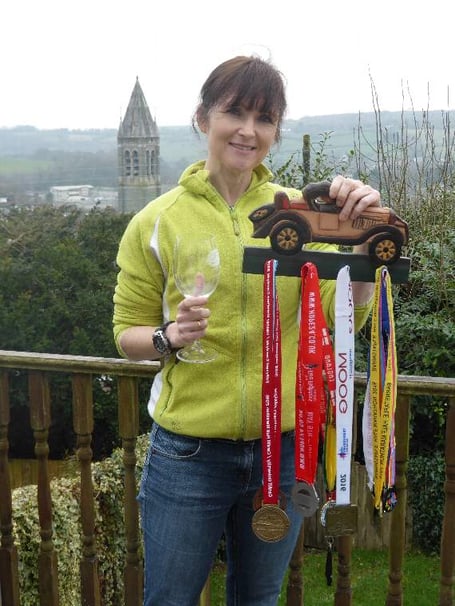
Running has provided a focus for TracyAnn Cole as she copes with the debilitating effects of MS
KEEPING fit and healthy is an incentive for any runner but for one member of Tavistock Athletic Club in particular, just to be pounding the streets again has to be regarded as real triumph over adversity.
TracyAnn Cole is determined that just because she suffers from the neurological condition, multiple sclerosis (MS), nothing will stop her from preparing for this year’s running challenges ahead.
It is a constant struggle for the 48-year-old, who is a carer/ support worker for Devon and Cornwall Care Services (DACCS), and whilst there is currently no cure for her condition, running provides a very important focus for both mind and body in her fight to be in control of this debilitating condition.




Health and fitness clearly play an important role in the Cole family with husband Stuart running a martial arts business and son Ben studying sport and social science at the University of Bath.
Astonishingly, TracyAnn’s MS had been present but undetected in her body for 19 years until June 2013 when she suffered her first major episode.
‘As usual, I went to training at the club on Tuesday evening but had returned home incredibly tired. That was very unusual. I went to bed early and awoke Wednesday morning experiencing what I thought was a stroke. A mild paralysis of the left side and failure to complete a few basic neurological tests proved to me immediately that it was serious, so I went to see my GP.
‘The GP told me to get myself straight to Derriford Hospital as it was not a stroke that was causing my symptoms.’
‘To be honest, at that stage, I was already expecting the worst, because of my symptoms, but multiple sclerosis definitely had not appeared on my radar. I knew very little about the condition. People with MS walk with a stick or are confined to a wheelchair and that clearly was not me. It just did not seem real.’
Very soon after diagnosis, TracyAnn had her first appointment with Jan Zieciek, MS consultant at Derriford Hospital. He gave a definitive diagnosis of Relapsing Remitting MS and the MRI scan showed it very clearly. It was also very active and very aggressive.
‘The bright white legion looked like a newly formed continent on the right side of my brain. I was quite shocked.’
At that meeting with Mr Zieciek, TracyAnn took along an MRI scan that was taken of her brain following a minor co-ordination problem of her left side in 1995. At that time, at the age of 28 years old and a business analyst, she was given no diagnosis and was told there was nothing to be concerned about and to ‘go away and get on with your life’.
That very MRI scan was kept and retained at home in the drawer for the next 20 years and life did indeed return to normal. When Mr Zieciek took the 1995 MRI scan and placed it on the lightbox he said almost immediately, ‘you had it then too!’.
‘You could have struck me down with a feather,’ TracyAnn said. ‘In all those years between 1995 and 2013, I had hardly had a day’s sickness. There had only been four occasions that illness had struck. But, when I did get ill, I got really ill.
‘I now know that I had only really experienced four episodes of my MS in all of those years. That is very lucky indeed. Most MS sufferers are not so fortunate.’
Unfortunately, the year 2012 had provided the ‘perfect storm’ of stress to cause that first major episode in 2013.
It was a short-lived family move up-country that TracyAnn believed was the trigger.
‘It was truly stressful,’ she said. ‘They say that moving home and bereavement are the most stressful events that can happen within a family and I couldn’t agree with that more.’
Having lived with MS for such a long time without even realising it, the major episode in 2013 was something quite different, however. Initial partial paralysis of the left side then developed into another neurological condition called hemidystonia. Hemidystonia causes muscle spasms and contractions along one entire side of the body, including the face.
‘It was hell on earth, no question,’ she continued. ‘At its worst, my whole day and night were punctuated with these hideous episodes. With each spasm and contraction of my muscles, the energy was literally draining from my body. By lunchtime, I was completely exhausted; drained of energy and in dreadful pain.’
Straight away Mr Zieciek recommended an intravenous drug called Lemtrada and treatment was scheduled for September 2013. Lemtrada is a disease modifying drug and works by binding to and killing immune cells (lymphocytes or white blood cells), which are involved when the body’s own immune system attacks itself and attempts to destroy the myelin that surrounds nerve fibres.
It is thought that the new cells that grow back after treatment, do not cause damage to nerve cells. In the first year, this involves a hospital stay of five days and daily IV infusions of Lemtrada. This is repeated over three days in year two.
Thankfully, by September 2013 TracyAnn was over the worst of her episode and slowly life began to return to some resemblance of normality. But, could that world include her first love, running?
‘Running has been an important part of my life since school. I did not want to imagine my new life without running, but I had to be realistic. Would the weakness in my left leg be permanent? Would I even be able to walk properly?’
A daily regime began with marching around the town. Walking was not that easy because TracyAnn’s left leg could not lift itself properly. As she recalled: ‘I would constantly say in my head, lift, lift, lift. It was actually easier said than done though.’
With a non existent immune system following hospital discharge, TracyaAn kept herself away from people by staying at home and focusing on her recovery alone. After a month, a bold decision was then made to return to the running track and Tavistock Athletic Club.
Those first few months were tough but TracyAnn’s steely determination did not wain. Walking was one thing, but attempting to jog again was quite another.
‘Everyone at the club was so welcoming and looked genuinely pleased that I was able to return,’ she said.
TracyAnn praised fellow runner, Tony Shearer: ‘I set myself a goal of being able to complete a single lap of the perimeter of Tavistock College both on a Tuesday and Thursday evening. Tony would accompany me every time without fail. I will never forget his support to me during that time.’
Over time, one lap turned into two laps and two laps turned into five. Strength was slowly but surely returning and the next challenge would be to complete the 2014 Bideford Half Marathon on March 10. After everything that had befallen her in 2013, just to get over the finish line would have been reward enough.
‘Yes, I was very nervous. A total of 13.1 miles is a long way, if things go wrong. I was still experiencing a few muscle spasms and its quite embarrassing if they happen in public. I was very self conscious.’
At the stroke of 10am, the gun went off and within a few minutes, a muscle spasm surged its way along TracyAnn’s left side.
‘I was now thinking that I was not ready for this and had actually made a big mistake attempting to complete the course. Swarms of runners swept past and the run continued to be peppered by the odd muscle spasm or two.’
With a bull dog spirit, TracyAnn battled her way around the course, accompanied by friend, Tony Shearer.
‘Once again, Tony was an absolute runner’s angel,’ said TracyAnn. ‘He stayed close by me every step of the way.’
Together, the two finally romped over the finish line in 2h 2mins.
‘I was absolutely amazed and promptly burst into tears.
‘Having reached the bottom of a very deep ocean, it felt great to finally reach the surface again and breathe air. I will never forget Bideford 2014.
‘From there on in, I started running better than I had ever run before. I started to take my training seriously. It was now my job to keep myself fighting fit and I continued training hard.
‘Since those dark days of 2013, I have to say that I’m very proud of my running achievements to date in the MS world. I was not going to ever give up without a fight and that continues to be the case always.’
It is quite incredible what TracyAnn has achieved since her official diagnosis: a half marathon personal best of 1.43, a first veteran 45 at Torbay Regatta 10K, a second veteran 45 at Totnes 10K, 55-miles at Hope24, the 24hr endurance run and second veteran 45 at the local Ultra Marathon Dartmoor Discovery over 32.5 miles.
This year TracyAnn, having already taken part in the Bideford Half Marathon, is planning to run the Dartmoor Discovery again.
‘First veteran 45 would be nice but I’ve got my second veteran crown to retain,’ she said.
TraceyAnn’s advice for people faced with a life changing diagnosis, is: ‘You literally have to fight for your life. If someone tells you it will not be possible, just aim to prove them wrong. After my diagnosis in 2013, I thought that I may never run again. Don’t get me wrong, I didn’t quite make it out unscathed. My left leg drags a little when Ive overdone it, my balance isn’t great and my energy levels are not good, but I battle on. What other choice do I have?’
Husband Stuart is rightfully proud of his wife’s achievements since her MS diagnosis. He told the Times: ‘TracyAnn is an inspiration to anyone who meets her. She never gets depressed and never complains. She’s a true fighter and I’m really proud of her and how she has come to terms with her condition.’
Martin Exley-Deane, chairman of Tavistock Athletic Club, said: ‘TracyAnn has been a valuable member of the club for many years. I say valuable because TracyAnn has not only been running for the club at road races and cross country, but she has assisted and led groups as a coach.
‘She has been a vital support to the Tavy Joggers beginners programme (coach to 5k) and has also been assisting junior coaching. Always leading by example, TracyAnn just gets quietly on with it.’
Comments
This article has no comments yet. Be the first to leave a comment.