

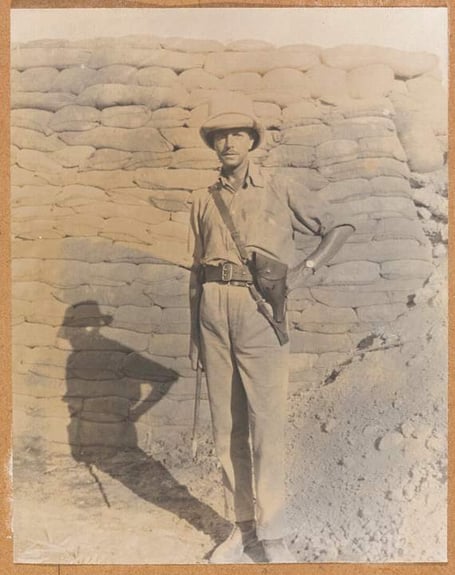
‘I WAS frightfully weary and utterly sick of the sound of rifle bullets’ — the dark reality of life in the First World War as documented by a soldier, who settled in Brentor, has been unveiled online for the first time as part of the National Army Museum’s Soldiers’ Stories series.
Rare personal diaries and letters belonging to Lieutenant Henry Curtis Gallup that vividly describe one of the British Army’s worst defeats in the First World War have now been published for the first time. Over a six-month campaign, the British Army experienced starvation — forcing them to eat their own horses — a lack of ammunition and widespread disease, all of which led to eventual surrender.
One hundred years on, Gallup’s personal accounts of his gruelling mission have been published on the National Army Museum’s commemorative online portal ‘First World War in Focus’ as part of the museum’s Soldiers’ Stories series.
Following Turkey’s entry into the war in 1914, Britain landed troops in Mesopotamia — modern day Iraq. Britain needed to protect its oil supplies and the British command was confident that it could rally the Arabs by defeating Turkey. Gallup’s unit, the Hampshire Howziter Battery, Royal Field Artillery, was sent to this unfamiliar land and was ordered to advance some 250-miles into Mesopotamia, to Kut and then Baghdad.

.jpeg?width=209&height=140&crop=209:145,smart&quality=75)

By November 1915, the British forces had made good headway to Kut. Their triumph was short lived though, as they quickly found themselves outnumbered and under intense pressure, having encountered relentless attacks from the Turkish forces.
Insufferable conditions
Gallup’s diary entries detail how continuous Turkish offensives and the insufferable conditions these ill-fated men had to endure eventually wore down the exhausted British forces.
He declared: ‘I was frightfully weary and utterly sick of the sound of rife bullets.’
By December 1915 food supplies were desperately low and the prospect of starvation was looming in the months ahead. Britain rallied its resources to relieve the beleaguered troops, sending two Indian divisions to Kut, but the relieving forces were halted by the enemy, with 23,000 casualties.
Extreme measures were taken to save the men with a ship load of stores sent after dark, but it was captured by the Turks. Gallup described how ‘we can only picture to ourselves the heavenly feed the Turks must be having’.
He also explained how planes were frantically ‘dropping sacks of grain, parcels of chocolate, any old thing in fact to enable us to carry on for a few extra days. But however hard the planes worked it was a mighty small allowance that each person got — the planes, of course, were greeted by heavy fire from Turkish lines.’
Trapped and under siege from the enemy, while yearning for food, Gallup vividly details how the men were forced to eat horse mince, horse flesh and ‘kabobs’ made of flour and fried in horse fat to stay alive. He was pining for substantial food:
‘I simply long for a piece of chocolate or a tinned apple pudding ... It is extraordinary how the idea of food absolutely obsesses one when you can’t get any.’
Third died of malnutrition
By the end of April 1916, the Kut garrison was starving, sickness was rife and with no prospect for relief, they surrendered on April 29.
Around 13,000 men, including Gallup, marched into captivity where they faced fleas, dirty water and cramped conditions, which caused a third to die from disease, malnutrition and cruel treatment by the Turks.
Henry Curtis Gallup (1874-1942) was born in Bloomsbury, London, and later moved to Sussex and then Wiltshire with his parents. Upon volunteering for service, he was commissioned as a second lieutenant.
‘Wish it was all over’
At the beginning of his service, Gallup was briefly hospitalised with jaundice and wrote home that ‘we are all very fed up with the war and heartily wish it was over now’. Little did he know the long journey ahead. Unlike many, Gallup survived captivity and was repatriated at the end of the war, settling back at home with his family in Devon. He went on to becomea major and died on November 3, 1942 at Langstone Manor, Brentor.
Dr Peter Johnston, collections content team leader at the National Army Museum, said: ‘The National Army Museum’s Soldiers’ Stories series allows us to better understand WW1 from the perspective of those who endured it. Gallup’s diaries and letters offer a unique glimpse into the battles that are sometimes forgotten, but are nevertheless important to British history. They allow us to understand what it was like to be a victim of war and the perils that came with it as well as the desire for home comforts, like chocolate, that added to the hardships faced by WW1 soldiers.’
Such personal accounts are being unveiled each month in the Soldiers’ Stories series. They piece together the development of the war from the point of view of those directly involved – 100 years from the time that they describe.
An interactive global map also features on the portal, which geotags all the major events of the war, as well as a timeline to help users piece together the development of the conflict and a host of learning tools. The website is a unique resource that will help commit the events of 100 years ago to the country’s national memory in one central place.
First World War in Focus is part of the National Army Museum’s Building for the Future project, which is supported by an £11.5-million grant from the Heritage Lottery Fund.
l To view Henry Curtis Gallup’s story, visit the website www.nam.ac.uk/ww1
Comments
This article has no comments yet. Be the first to leave a comment.