

Times reporter Lindsey Turpin uncovers some of the secrets of the final resting place for many a Tavistock resident.
MANY people drive past Dolvin Road Cemetery in Tavistock every day but are unaware of the many interesting features that lie beneath its surface.
Did you know that within the grounds the Church of England graves face east to west and non-conformists north to south? Or that in the south east corner of the cemetery are two cholera burial graves for young children, which were kept a distance away from other graves.
Dolvin Road Cemetery houses some 7,000 persons in a mixture of graves, vaults and unmarked plots, some of which are the last resting place of Tavistock’s elite from the 19th century, including well-known librarian William Merrifield and Theopholis Jones, the architect responsible for many of the Duke of Bedford cottages.

Between 1614 and 1845 some 22,000 persons had been buried in the Tavistock parish churchyard and around the 1830s concerns were being expressed that the yard was full and creating potential health problems with body parts becoming visible and an unsavoury odour surrounding the yard.
In early days non-conformists could not be buried in the parish churchyard without the permission of the vicar. Although the Unitarians had enjoyed the facility of burial in their Abbey Chapel grounds from the late 18th century, this ground too was becoming full and in the early 1830s representation to the Duke of Bedford, who owned the land, resulted in ground in the western end of the Dolvin Road Cemetery being given solely for non-conformist burials. The ground received its first burial in 1834 — ‘Eliza Ann Robjohns (daughter of) Charles and Elizabeth Robjohns who died April 30, 1834. The 1st interred in this cemetery’.
Alex Mettler, chairman of the Tavistock and District Local History Society, whose members, have spent many hours transcribing the details of each and every grave in the cemetery, said: ’When arms and legs started coming out of the graves in the churchyard it was realised something had to be done and the Church of England needed to ask the Duke of Bedford to give them some land.
‘However, the non-conformists got to the Duke first and were given the first piece of land in Dolvin Road in 1834. Then soon after the Quakers were given a second piece of land by the Duke; the Quaker Chapel closed in the early 1870s and this ground was then given to the established church for use as a burial ground.
‘The third part of the Dolvin Road Cemetery was given to the parish church in 1845 and, at the same time, the non-conformists were given a fourth piece of land — you can tell which part you are in, generally, by how the graves are placed. If you were non-conformists then your grave would have been placed north to south and conformists east to west.
‘This unique corner of the town thus comprises four separate burial grounds.’
Within these grounds there are buried some 3,200 non-conformists and 3,500 from the established church, including some 17 cholera victims.
Searching through the cemetery it is quite astonishing to see that amongst those buried there how many are children of under ten years of age.
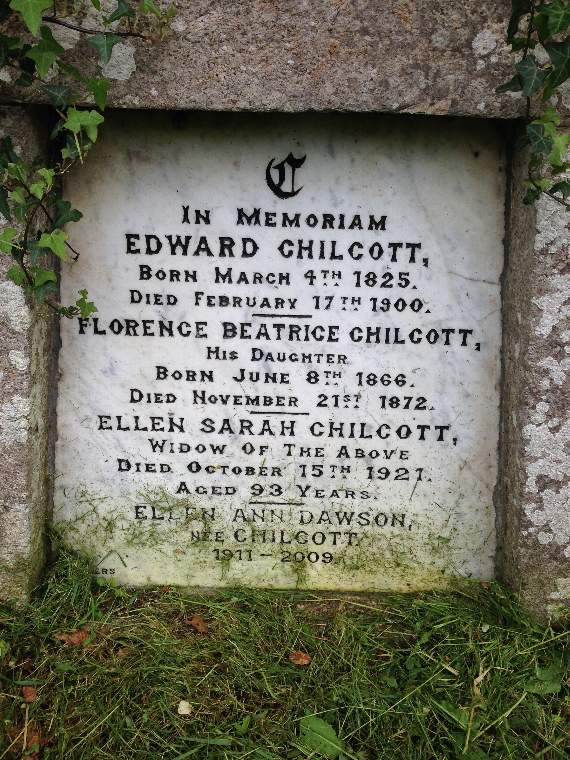
The cemetery was open for burials until 1883 when an Act of Parliament saw many burial grounds in England being closed around the country due to their being full to capacity. However, to this day, there is still a clause where family members of those buried in a vault or bricked up grave can join their relative – with one woman doing so in 2009. A vault set in the bank of the cemetery (pictured) was originally for Florence Beatrice Chilcott, 1866 to 1872, and after the graveyard was closed in 1883, Florence’s father Edward Chilcott, 1825 to 1900, was buried; then Ellen Sarah Chilcott, who died 1921 aged 93 years, followed by Ellen Ann Dawson, née Chilcott, 1911 to 2009.
Well known names from Tavistock’s past buried within the non-conformist grounds of Dolvin Road include Theopholis Jones, who died in 1858; he was the surveyor for the Duke of Bedford.
Captain James Richards was the manager of the Devon Great Consols Mines for 30 years and lived at Tamar View House — now the Horn of Plenty — until his death in 1878.
William Merrifield is buried within a tomb in the Church of England burial site. He was a well known librarian and early photographer from Tavistock, born in 1804 and died 1885.
John Richards was buried in 1850. He was the founder of the Tavistock Brewery which was behind the Tavistock Inn next to what is now the Co-op store on Brook Street. The Tavistock Inn was formerly a house for his mother, Anna Maria. The pub was established in the 1890s when the brewery belonged to Flowers and Co. John is buried with his wife, also Anna Maria, and their son John.
Within the established church plot there is a tomb for the Northway family who ran the Exeter Inn (now the Tavy Club) the Queen’s Head (formerly Browns Hotel, a business family who had 179 man years of running pubs in Tavistock.
Such families lie together with names such as Edward Spencer, headmaster of Tavistock Grammar School; the Gill family members, bankers and landowners; and the Collacott family, still resident in Tavistock today.
There are not many epitaphs of note or humour on the gravestones but one in the consecrated section reads: ‘She was, but words are wanting to say what, think what a good wife ought to be and she was that’.
From the well known to the wealthy, the young and the old, the cemetery offers everyone living a glimpse into the town’s past from more than 180 years ago.
Comments
This article has no comments yet. Be the first to leave a comment.