

.jpeg?width=752&height=500&crop=752:500)
A CAMPAIGN to get the famous Abbot’s Way across Dartmoor changed on Ordnance Survey maps to the original historical route has had a breakthrough.
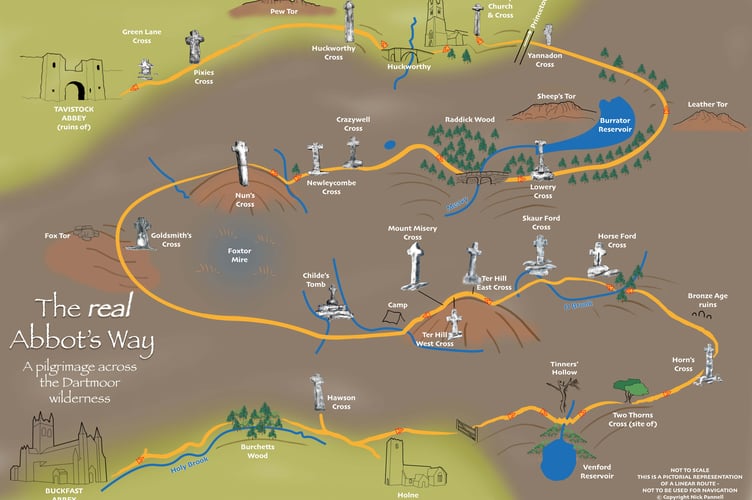
Public body Historic England has agreed that the current route, which takes a more southerly path on its most eastern stretch is not the historical one.
Nick Pannell, author of a new book about the 700-year-old monastic route between Buckfast Abbey and Tavistock, has welcomed the clarification.
He said: “Just because the OS route has been marked on the map for over 100 years, doesn’t mean it should continue to be when there is a clear consensus among Dartmoor antiquarians that it’s wrong.




“The more northern route, starting on Holne Moor and following a line of ancient stone crosses, is the right one and so much more interesting as the crosses are all ancient monuments, full of character and history. I spent four years researching the route of the Abbot’s Way for my book and I’m in no doubt that the eastern section of the 22-mile Abbot’s Way should be redesignated.
“There is no path as such between the waymark crosses as it was abandoned years ago but there isn’t one either on the OS route. But in time, if rerouted, interest will grow hugely and walkers have the real experience of navigating by these hilltop waymarks.”
Historic England said: “Historical features are listed in italic script, and we can see all the crosses are marked in this way. The ‘Abbot’s Way’ text on the map, however, is not in this italicised script, so is not there as a historic feature. We think this is probably included as the name of a modern public right of way (created as a recreational path).”
The more northern route, however, is ancient says Historic England, citing the Mount Misery cross as being “on the Abbot’s Way”.
OS have previously said it will follow the lead of Historic England stating: “Changes must go through Historic England. This is the recognised authority considered by OS on these matters”.
Nick said: “So there we have it. The case is made and I will be presenting this evidence to Ordnance Survey.
“Many people will think this doesn’t really matter, that from Nun’s Cross onwards everyone agrees, but by taking walkers on the more southern route, they are missing out the best part – the chance to see a whole procession of crosses, some of which you can still navigate by.”
“It’s also an inspirational route for those for whom a cross on a remote hill has special meaning. It means this Abbot’s Way can take the form of a pilgrimage, following in the footsteps of a remarkable order of monks who were radical in their lifestyle and had ideas as relevant today as they were 700 years ago.”
In all 18 crosses survive, many repaired after centuries of vandalism. The oldest dates from the 13th century.
Nick said: “We owe Dartmoor antiquarians a debt of gratitude for hunting down the various bits of the crosses that had been lost or reused as gateposts etc. Some were broken and had to be reattached. But it makes the crosses all the more interesting - weathered survivors of all that nature and man could throw at them.
Nick is the author of ‘The Real Abbot’s Way: A pilgrimage across the Dartmoor wilderness’.
Comments
This article has no comments yet. Be the first to leave a comment.