
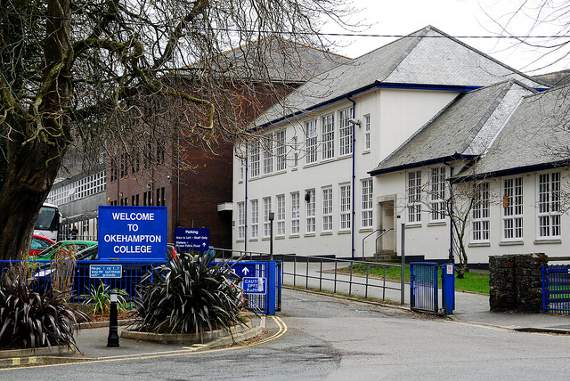
OKEHAMPTON Primary School and Okehampton College have announced they are working with a number of other schools in Devon — including several in West Devon — to form a multi-academy trust.
A MAT is a group of schools that work together in a formal arrangement; all schools within a MAT are governed by a single board of trustees responsible for decisions relating to how each school is run.
There will still be a local governing body which will monitor and challenge the quality of education in each school.
Hazel Fox, headteacher of Okehampton Primary School, said: ‘The multi-academy trust would mean that the proposed schools and colleges would join together and work in a formal arrangement with funding coming from central government.’




‘There are many benefits to a multi-academy trust, including excellent staff training for all of the schools involved in the multi-academy trust. The reason these schools in particular have joined together is because each share similar values.
‘Similar to the operation of a business, there would be a board of trustees responsible for decisions relating to how things are run within the schools.’
Keri Quertier, chair of governors for Okehampton Primary School, said: ‘Each school involved would benefit from being part of the proposed academy in terms of the quality of education for the children.
‘We believe that to ensure that all of our children continue to receive the best possible educational opportunities, we must partner with like-minded schools. Similarly, if we are going to attract the best and develop our existing staff we must be part of a larger educational community. Traditionally we would have looked to our local education authority to provide such challenge, advice and support.
‘However, with continued local authority cutbacks and the diversion of funding directly into schools, this service is becoming more and more problematic. Our experience of local informal partnerships to date has been encouraging and we have already joined the Dartmoor Teaching Schools Alliance based around Okehampton College.
‘We therefore see the formalising of our partnership arrangements as being the next logical step. Furthermore, we believe that by proactively choosing and forming the structure and ethos of the partnership, we can ensure that our local community, for both today and tomorrow, is best served.’
Each school within the MAT would become an academy, though locally there would be little change. Schools would still retain their individual names and uniform policies. There would still be a headteacher on-site, responsible for the day-to-day running of the school.
There would still be a local governing body which would monitor and challenge the quality of educational provision in the school. The difference is that in future, individual schools will be supported by the Dartmoor MAT’s board of trustees. These trustees would have legal responsibility for monitoring the quality of education across the schools in the MAT and ensure the appropriate resources are made available.
Becoming an academy also means that funding from central government is sent directly to each school, which can then decide where all the monies are spent to best effect.
The schools would go into the trust with Tavistock College, Holsworthy College, Queen Elizabeth’s in Crediton, Chagford Church of England Primary, Lydford Primary, Boasley Cross Primary, Bridestowe Primary, Exbourne Church of England Primary, North Tawton Primary, South Tawton Primary, Bradford Primary, Black Torrington Church of England Primary, Bridgerule Church of England Primary and Northlew and Ashbury Church of England Primary School.
All of the schools have expressed an interest to form the MAT with the local office of the regional schools commissioner (RSC). The RSC will then ensure the proposals would work and eventually decide if the MAT can go ahead. The next step is for the schools to submit a formal application to the RSC.
Such an application would outline in more detail the governance structure of the MAT and provide basic information about each school. If the application is approved each school receives a one-off grant to cover the admin and legal cost involved in converting from a local authority-controlled school to an academy.
Part of the process will be consulting with parents, staff and other stakeholders. The schools intend this to be in the form of written briefs and open meetings — though no dates have yet been confirmed for such meetings.
Schools are hoping to have their application accepted by Easter. The conversion process can then typically take six months. At the end, the MAT is formally created and all sign a funding agreement directly with the Department of Education.
Comments
This article has no comments yet. Be the first to leave a comment.