

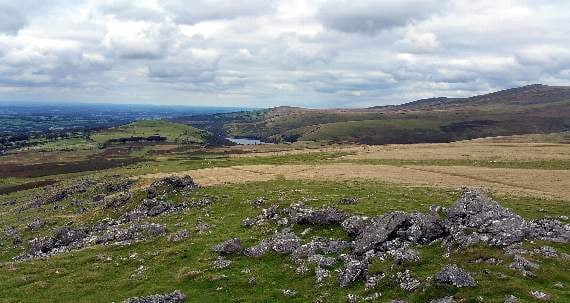
NATIONAL Parks England has called for the Government to protect the future of farming after data revealed that there has been a reduction in the amount of land in national parks under an agri-environment agreement.
Agri-environment agreements enable farmers and land managers to farm in a sustainable way that supports and enhances natural capital assets such as biodiversity and landscape quality, as well as air, water and soil quality amongst others.
Dartmoor National Park has seen a decline in agreements of just over 17% since 2015, but in other parks it has been as high as 30%.
National Parks England is calling for a three-point plan which it hopes will secure the continued security and productivity of farm businesses as they transition from Countryside Stewardship, the current set of agri-environment schemes, to the new Environmental Land Management Schemes (ELMS).

Margaret Paren, chair of National Parks England, said: ‘Getting ELMS right in National Parks is critical, as farming is central to the fabric of our National Park landscapes and the wider rural economy. We are encouraged by the Government’s stated objectives for ELMS, but we cannot wait until 2027; we must act now to ensure we do not see environmental damage to our most treasured landscapes as land comes out of agri-environment agreements. We need to secure a viable future for our farmers that combines high-quality food production with provision of public goods such as better biodiversity and high-quality landscapes. We have highlighted some suggested changes and are keen to work with colleagues in Defra and Natural England to address this issue.’
National Parks England is calling for:
• Higher Level Stewardship schemes to roll over- National Parks England is asking the Government to facilitate extensions to existing Higher Level Stewardship schemes that are delivering against the 25 Year Environment Plan, and to ensure that there is advisor capacity to achieve this.
• A review of the Countryside Stewardship scheme- higher tier Countryside Stewardship offers a restricted menu of choice, while mid-tier options need to be a more attractive proposition for farmers and with a clear focus on delivering public benefits. Such changes could help farmers make the transition to ELMS.
• The inclusion of all National Parks in the pilot scheme for ELMS- all National Parks should be included as part of the forthcoming national pilot for ELMS beginning in 2021. This would provide an opportunity to accelerate the transition to the new system and ensure availability is linked to the reduction in the Basic Payment Scheme, which is currently the biggest EU funding stream for farmers.
Comments
This article has no comments yet. Be the first to leave a comment.