

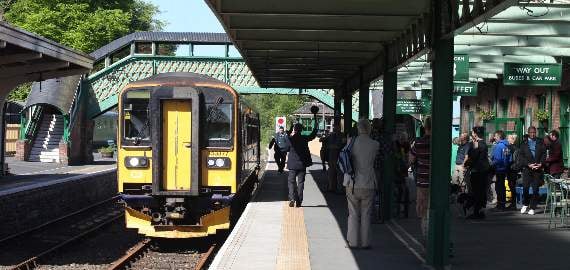
SUMMER Sunday trains running between Okehampton and Exeter will return later this month.
The Great Western Railway (GWR) service, funded by Devon County Council, will run four trains each way between Okehampton and Exeter every Sunday, from Sunday, May 20 to Sunday, September 9.
The service, which was launched in 1997, is part of the ongoing efforts to reintroduce regular services on the line.
Councillor Andrea Davis, Devon County Council Cabinet Member for Infrastructure, Development and Waste, said: ‘The Summer Sunday services always prove popular with passengers, and we’re pleased to be able to help these services return for another summer. We share the ambition for regular services to Okehampton to be reintroduced which is why the county council has provided its support for this service since 1997 and why we have been exploring options for a new station for Okehampton. The support from Government is vital in reinstating the services.’




Councillor Kevin Ball, Devon County Councillor for Okehampton Rural, said: ‘Okehampton is a great destination in the foothills of Dartmoor and provides easy links to the Granite Way cycle route, so the Sunday train is a great opportunity for people from other parts of the county to come and visit Okehampton and the northern moor, not just an opportunity to visit Exeter! I am grateful for Devon County Council’s support of this service again this year.’
The announcement follows the recent second successful special trip of the Royal Oke, organised by campaign group OkeRail in partnership with GWR, to highlight the demand for regular services.
The special service took more than 300 passengers from Okehampton to Oxford and Stratford-Upon-Avon on April 21 – similar to the trip organised to London in 2017.
Mike Davies, chairman of the OkeRail Forum, said: ‘The reintroduction of regular services on this line are vital to over 100,000 people who haven’t had a train service for almost 50 years.
‘I would encourage as many people as possible to make use of the Sunday Service as it continues to prove our case for the importance and usefulness of a passenger service to Okehampton.’
Comments
This article has no comments yet. Be the first to leave a comment.