


Former mayor of Okehampton, Peter Woodgate, widely regarded as the architect responsible for much of the town’s modern character, died peacefully on January 20, aged 93.
Peter’s desire to improve the environment around him, and his lifelong commitment to the community, stemmed from early experiences that also helped form his resilient and determined character.
Born in Devonport on April 20, 1932, his childhood was affected by the upheaval of war. In 1941, during the Plymouth Blitz, his family home was destroyed, prompting their evacuation and eventual settlement in Okehampton.
After completing his schooling in the town, Peter began his working life as a carpenter, later moving into the building trade. He then enrolled on an architectural design course in Exeter, which he attended in the evenings after long days on the construction sites. His aptitude for design was quickly recognised by his tutor, who encouraged him to pursue architecture as a profession.
-pasta-dish-while-watching.jpeg?width=209&height=140&crop=209:145,smart&quality=75)

After qualifying, Peter moved to London, where he worked as an architect for Selfridges on Oxford Street. It was there that he met his future wife, Betty, and the couple married in London in September 1962.
After several years in London, Peter and Betty returned to Okehampton to start a family, settling in the town he loved most and where he would remain for the rest of his life.
He soon joined architect Robin McMillan-Scott’s practice, then based in the former Midland Bank Chambers on Fore Street. Drawing on his strong local connections and experience in the building trade, Peter helped the practice secure significant commissions. He later became a business partner, and the firm McMillan-Scott and Woodgate went on to operate successfully for more than three decades.
During his career, Peter was responsible for a vast number of projects that helped shape Okehampton’s urban landscape, including the Red Lion Yard, numerous housing developments, and The Glen on Castle Road. The Glen received national recognition in 1979, winning a Good Design in Housing diploma from the Secretary of State for the Environment.
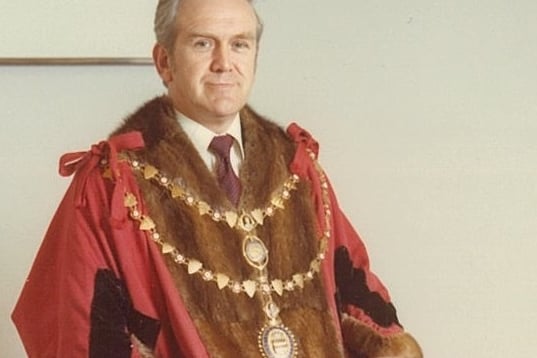
Beyond his professional work, Peter played an active role in civic life. He served as president of Okehampton Rugby Football Club, chairman of the Board of Governors at both schools, was a town councillor for many years, and Mayor of Okehampton in 1977. That year coincided with the Queen’s Silver Jubilee and the twinning of Okehampton with Craon in France; a relationship that continues today.
Peter’s commitment to Okehampton continued well beyond his time in public office. In the early 2000s, he played a central role in the town’s development scheme, producing a concept plan that enhanced Okehampton’s appearance by bringing together its natural setting, heritage, and public spaces.
The town underwent a major transformation, with Peter’s meticulous attention to detail reflected in features such as the curved lampposts, public artworks celebrating Okehampton’s links to Dartmoor, and subtle references to its market history.
A founding member of Okehampton Museum, he possessed an extensive knowledge of the town’s history, which informed much of his work.
Peter Woodgate’s influence is deeply embedded in Okehampton itself, leaving a legacy that will continue to shape the town for generations to come.
He is survived by his wife Betty, his three daughters and three grandchildren.
-when-he-was-president-of-Okehampton-Rugby-Football-Club.jpeg?width=752&height=500&crop=752:500)
Comments
This article has no comments yet. Be the first to leave a comment.