
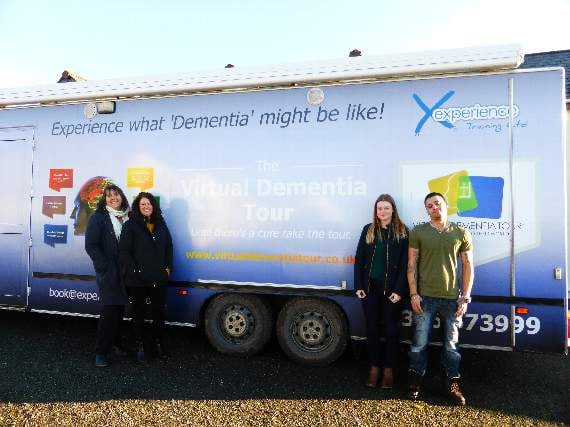
Is it possible for someone of a sound mind to understand how someone with dementia really feels? Reporter Sally Shipton undertook a virtual dementia tour in the hope of answering this question.
RECENT studies can tell you there are 850,000 people living in the UK with dementia, that it is a diagnosis for different brain disorders that trigger a loss of brain function and an incurable condition feared more than cancer.
But what statistics cannot tell you is the fear, vulnerability, frustration and utter despair felt by dementia sufferers on a daily basis.
In order to experience what it might be like to suffer with the condition, I took part in a virtual tour that aims to educate people about what it’s like to live with dementia.




The Virtual Dementia Tour is a mobile immersive experience run in the UK by the care-training provider Training2Care, which uses props to take away people’s primary senses, distorting their surroundings and simulating the physical symptoms of dementia.
It is hoped the experience will show that a person with dementia is not challenging or aggressive but is instead experiencing life in way that is full of trepidation.
By a lorry parked outside West Heanton Residential Home in Buckland Filleigh, I join 12 careers who are equally anxious about participating in the experience. In groups of three we are given a set of instructions, before being ushered into the back of a lorry.
I am stood with my arms folded. There is a confusion of noises and my vision is distorted. It’s dark. My hands are numb and there’s a sharp sensation in my feet. A hand brushes against my face, making me jump.
I faintly hear a person say ‘do something useful’ but how can I? I stumble around for what feels like forever attempting to figure out my surroundings.
I notice that I am not alone as I see the outline of others. I rifle through a pile of objects that seem to be bedclothes. A man stands next to me barking orders, but I can’t make out any words, only loud noises. He is too close, leering over my shoulder. I feel agitated and uncomfortable.
I shuffle away from him but he follows. He takes my arms and reluctantly I am lead to a chair. I sit, hoping that if I do so I will be left alone. There’s a fluffy object on the chair, I can’t work out what it is so I just hold it for a few minutes and stare into space.
Suddenly, a plastic spoon hits my chin. Someone is standing over me, repeating this action and attempting to force the spoon into my mouth. I move my head, it continues. I lash out, it continues.
Other figures emerge, and the feeding stops. I see four or five people coming closer but my vision is blurred — I don’t recognise them.
They begin talking but their words are just white noise. They start touching my face, arms and legs. I scream. And then, just like that, someone leans in and removes my headphones.
Anyone who has cared for someone with dementia will recognise many of the behaviours I exhibited, such as standing still in the middle of a room, stumbling, failing to follow instructions, not knowing what to do with an ordinary object, staring into space, lashing out, screaming. So why was I, a person without dementia, behaving like this?
The truth is, I was terrified. Although I knew it was a simulator, the sensations felt real and my reactions were too. The lorry was like a dementia tardis that simulated the world of someone with mid-stage dementia.
The lorry, the first of its kind in the UK and only the third in the world, will be travelling the country this year, giving carers an insight into the world of people with dementia. The experience is intended to improve the care they give.
Tracy McKay, a carer at West Heanton Residential Home, said: ‘I think the tour aims to give people more of an awareness and understanding of dementia patients and what they are going through. As a carer, the virtual tour has given me and other members of staff a further understanding of how people with dementia struggle with everyday life, either in a care home or in their own homes.’
Glenn Knight, chief executive of Training2Care, said: ‘Dementia is one of the biggest killers in this country. There is no cure. It is so vitally important people are made aware of what it might be like to be a sufferer with the condition.
‘During the virtual tour people experience absolutely everything that dementia sufferers go through. We put insoles into their shoes to represent peripheral neuropathy where the nerve endings die in your feet and in your hands.’
‘It makes people with dementia walk with what’s known as a shuffling gait. If you think about walking across a pebbly beach with no shoes on, that’s pretty much what it would feel like. This is why people with dementia walk around with no shoes on, shuffle when they walk and constantly sit down, because they’re in pain.’
Participants taking the tour are also given gloves to take away their sense of touch and glasses to impair their sight, simulating macular degeneration and presbyopia (blurry near vision which is caused by loss of elasticity of the lens).
Mr Knight added: ‘We put sounds into people’s headsets at the right volume for people with dementia because they hear at slightly higher volumes but they also lose the ability to block out sounds. Add all these elements together and this causes the reaction of sub-vocalisation, humming, laughing, shuffling gait, talking to yourself out loud and talking about what you are thinking.’
The actions of dementia sufferers can be difficult to comprehend, however, one of the most valuable and enlightening aspects of the tour was learning that emotion fuels behaviour. It is understandable that someone confused would stand still or wonder about their surroundings, or that someone scared would lash out.
As Mr Knight explained, while a person with dementia may be safe in the care of others, the individual with the condition may not feel that way. They may feel scared, alone, vulnerable, bewildered — or all of these at once.
In answer to the initial question: is it possible for someone of a sound mind to understand how someone with dementia really feels? I would say no, not fully. We can take off the headphones, remove the glasses and to be free from the torture. For people with dementia, it is something they face every single day.
The importance of communication, kindness and patience when around dementia sufferers is something I will not forget.
Dementia facts
• Dementia is caused by different diseases. The word ‘dementia’ is just an umbrella term for the symptoms caused by these diseases such as memory loss, confusion and personality change.
• Alzheimer’s disease is the most common cause but other dementias include vascular dementia, dementia with Lewy bodies and frontotemporal dementia.
• Dementia is more than just memory loss – the condition affects people in a wide variety of ways which might include changes in behaviour, confusion and disorientation, delusions and hallucinations, difficulty communicating, problems judging speeds and distances and even cravings for particular foods.
• There are 850,000 people living with dementia in the UK today (1.3), including over 700,000 people in England, over 45,000 in Wales, nearly 20,000 in Northern Ireland and 70,000 people in Scotland.
• By 2025 the number of people with dementia is expected to rise to over one million and by 2050 it is projected to exceed two million.
• Dementia is not an inevitable part of getting older – while it’s true that the majority of people with dementia are over 65, the condition is not a normal part of getting older. The likelihood of developing dementia rises with age, but it’s not a given that an older person will develop it. In the UK over 40,000 people under 65 have dementia.
• It’s possible to live an independent and active life with dementia – there are many people in the UK and across the world who are facing dementia head on and developing support mechanisms and strategies to live well with the condition.
• Dementia has a bigger impact on women – with more and more women living well into their 80s, half a million women in the UK are now living with dementia.
• Investment in dementia research is still low – despite a welcome Government focus on dementia over the past three years, research into the condition still only receives around three per cent of the Government’s medical research budget.
• There are no treatments to stop the diseases that cause dementia – while some treatments can help people to live with their symptoms a little better, there are no treatments that slow or stop diseases like Alzheimer’s.
• Dementia doesn’t discriminate as it is a condition that can affect anyone regardless of background, education, lifestyle, age or status.
• Dementia is a global issue affecting 46-million people worldwide.
Comments
This article has no comments yet. Be the first to leave a comment.