

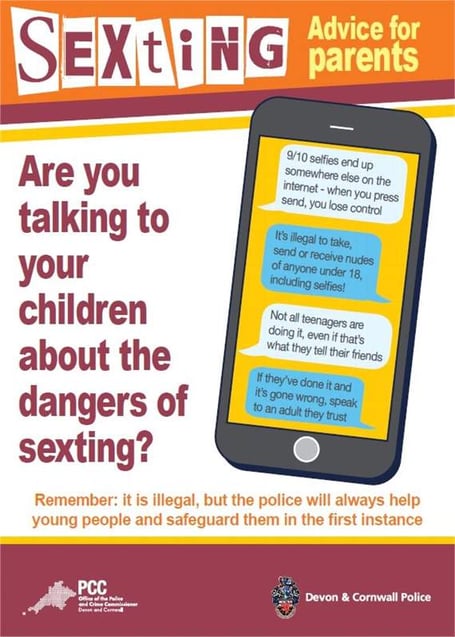
The campaign is aimed at alerting parents to what sexting is, and also to advise them and their children what to do if a youngster presses the ‘send’ button – and launches a naked image of themselves off into cyberspace.
Sexting is the term used for the sending or receiving of sexual, naked or semi-naked images or videos taken by a young person of themselves (a selfie), or by others.
It is illegal for anyone to take, send, receive or share these types of images of anyone under 18 – and that includes selfies. However, Devon and Cornwall Police says their primary concern is to avoid criminalising young people where it is not appropriate. Instead, they are urging parents and children to have an honest conversation about the issue.
.jpeg?width=209&height=140&crop=209:145,smart&quality=75)



Reports of under 18s sexting in Devon and Cornwall have nearly tripled in recent years, from 115 reports between November 2015 and October 2016, to 440 reports between November 2016 and October 2017.
Superintendent head of the prevention department, Matt Lawler, from Devon and Cornwall and Dorset Police, said: ‘Education and safeguarding is at the forefront of all we do with young people as a police force. We want to re-affirm to young people and parents that we are here to help when you need us.
‘Technology has become ever more advanced and available. This is why our sexting campaign is of such importance. By educating young people about the law around sexting and the potential consequences of sending these types of images, we can help them to avoid making a decision they later regret.
‘Devon and Cornwall Police’s primary concern is to avoid criminalising young people where it is not appropriate and we hope that by educating young people about sexting we can avoid this altogether.
‘Our main message to young people is this: when you press send, you lose control of that image – where it ends up on the internet and who sees it – you’re not just breaking the law.’
The police are urging parents to have honest conversations with their children about sexting, and ask them to speak to an adult they trust if they’ve done it and gone wrong. They stresses that they want to help and safeguard young people rather than criminalise them, even though sexting is technically illegal.
Alison Hernandez, police and crime commissioner for Devon said: ‘Sexting is a growing concern as most young people now have, or have access to, a mobile device.
‘It is important that young people understand the law surrounding sexting and the consequences it can have.
‘As a parent myself, I feel it is also vital that parents and guardians have an understanding of the topic and are provided with the correct tools and information to proactively talk to their children about the issue.’
Parents looking for advice can visit dc.police.uk/advice/ parenting, while young people are signposted to dc.police.uk/youth/ sexting
Comments
This article has no comments yet. Be the first to leave a comment.