

A TEACHING method of helping school children, teenagers and parents overcome a range of issues from anxiety and stress to depression — and even self harming — is producing positive results in West Devon schools.
The method, called Emotional Logic (EL), was developed by a Devon doctor in the 1990s as a lifelong learning, conversational version of systemic family therapy. EL is not counselling or therapy, but a conversational skill that builds relationships so the person affected can be taught to develop the resilience and strategies necessary to find solutions to their own problems.
It helps people of all ages to understand how unpleasant, loss emotions all have a useful purpose when seen as part of an integrated process of adjusting to change, disappointment, setback or hurt.
Such is EL’s success that it is now being used regularly in local schools, including those that are part of the Tavistock Church School Federation.



.jpg?width=209&height=140&crop=209:145,smart&quality=75)
Christiaan Stirling, who for more than 20 years has worked in primary schools in Tavistock, Plymouth, and north Devon including as a deputy and headteacher, for the past two years worked for the Emotional Logic Centre (a not for profit charity), which is based at Ivybridge.
He now travels around to schools teaching EL techniques to teachers, parents and pupils as well as working with youngsters and their families on a one-to-one level to help them solve their issues.
Schools in Callington, Stoke Climsland, Tavistock and Okehampton are among those which have invited Christiaan to help certain pupils or provide training for staff and parents.
Christiaan, aged 48 and a former deputy head at the Tavistock Church School Federation, told the Times: ‘What children need to understand, and not just children, is that we all go through natural emotional cycles — from being happy and jolly one moment and then, perhaps, after someone has upset us or there is a misunderstanding, we have an instinctive, emotional reaction which may cause us to feel a variety of feelings such as sadness, anger or shock.
‘Nobody can go through life without any conflict and when we get into these situations your mind and body tells you to either fight or flight.
‘Often people can deal with these emotions quickly and work through this, reacting accordingly but this is not always the case. We all respond differently to life’s pressures at different times, for example, you may have a child who may be in an abusive relationship, or a child who is experiencing their parents’ relationship breaking down. Many people, at different times in their lives, understandably, cannot move on and they get stuck in the uncomfortable emotions without being able to see a way out.
‘None of us are superhuman. We all have bad days. Sometimes we have terrible days, people lose their jobs, have health problems to deal with, their wife or husband might leave them, they worry about their loved ones or their future. These things happen in life and some people get to a point where they are unable to cope with these losses and deal with their emotions.’
Christiaan said that perhaps a famous example of someone who used their anger for its in-built useful purpose was Nelson Mandela, who opposed the apartheid of white and blacks in South Africa. At first his anger turned to rebellion and violence but after many years in prison he learned how to channel his emotions in an assertive, rather than aggressive manner and his example of forgiveness and acceptance eventually led to victory over his oppressors by peaceful means.’
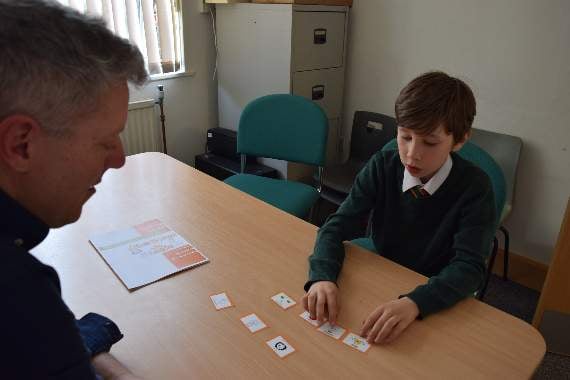
Children are helped to explore their problems by specifically listing their losses and learning how to deal with the resulting emotions. They learn through EL about the key emotional stepping stones, identified by the UK Hospice movement; words such as ‘acceptance, anger, bargaining, denial, depression, guilt, loss’. Each of these emotions has an in-built useful purpose. If the children can recognise this they will be able to use the emotion in a way which will help them move forward. Children use simple props such as ‘emotional stepping stones’ — cards to help them express how they are feeling and then put together, with their mentor, a personal, values based ‘action plan’ to help overcome their anxieties and fears.
‘A good analogy behind Emotional Logic is the well-known Chinese proverb — “Give a man a fish and you feed him for a day. Teach a man to fish and you feed him for a lifetime”.’
That principle can certainly be applied to the benefits of EL.
‘For example,’ said Christiaan, ‘We teach children about bargaining and acceptance, including the differences between aggressive, passive and assertive bargaining.
‘In reality a child could get what they want by using aggressive behaviour in the short term but this action does have consequences — for example that child would not be popular with the other children because of their behaviour and there will be serious and significant conse-quences for that individual once the school discovers what is happening.
‘Another common situation is that a group of girls at school decide to ostracise one of their group and that girl has to deal with the emotions of suddenly finding herself rejected. It is all about rebuilding relationships. We would help the child list their losses and design a personal action plan to start very quickly getting back some of what has been lost. For example the child could perhaps invite one of the members of her friendship group over for a sleep over and start an individual rapport with that girl to slowly rebuild their relationship.
‘That essentially is what it is all about — developing deeper and healthier relationships with people to a point where you can trust them on a deeper level.’
One man who Christiaan met, whose child was struggling with emotional issues, was in the Armed Forces and served in Afghanistan. He had issues from that conflict that he himself had never resolved. He recognised in the EL cards that he too had a regular shock reaction whenever he thought about the incidents he had experienced and was looking for a ‘safe place’.
Up until that point his safe place at the time was in a pub talking to his Army mates about anything but what had happened.
As Christiaan says none of us are immune.
‘Using EL we can help people of all ages to work through their uncomfortable emotions, to understand them more deeply and come through the other side. We can bring hope for the future. There is always hope for the future and people should never give up.
‘After working with us people often feel they finally have some level of influence over where their lives are going as they begin to win back some of their losses. Often a result of going through the EL process people change habits of a lifetime and begin to appreciate the many blessings that we all have in our lives.’
n IF anyone would like to find out more about how EL can help them or be used in their school or workplace contact the charity for further info — go to the website at www.emotionallogiccentre.org.uk
Comments
This article has no comments yet. Be the first to leave a comment.