
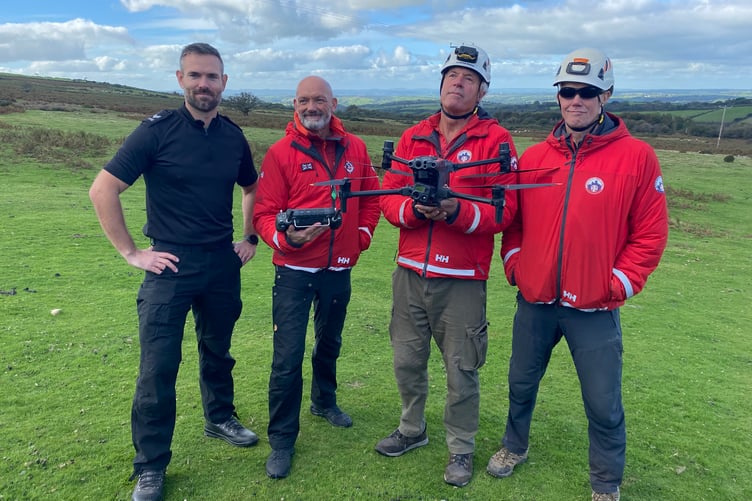
Volunteer rescue teams are being equipped with high tech ‘eyes in the skies’ to give them a big boost in their ability to find missing people.
Mountain rescue teams in the South West are being trained by police who have donated an upgraded version of the volunteers’ current drones.
The new drones can fly in all weathers, mist and darkness and have floodlights, giving teams such as Dartmoor Search & Rescue Team Tavistock (part of Mountain Rescue England and Wales (MREW)) an advantage when looking for injured walkers, those in distress and those lost and missing on the moors and other mostly rural areas.
The drone operators guide the drones and receive images from the onboard cameras. The aerial pictures can also be sent back to the search operations’ command centres. The drones also have some ‘intelligent’ features allowing autonomy of navigation if needed and the ability to avoid obstacles such as pylons, overhead cables, hills, tors and the ground itself.
Alec Collyer, drone lead for the Peninsula Search and Rescue (PenSAR), the regional mountain rescue body, said: “These new drones are a huge step in capability for mountain rescue groups. We have been limited by the old drones because they could only really be useful in daylight and good weather.
“But we’re often deployed in bad weather when people are more likely to get lost, especially on Dartmoor when the weather can change quickly. The new drones will allow us to fly in the dark with their floodlights giving us an aerial view of search areas and hazards to the operator and command centres. The lights will also be useful in lighting the area where the teams locate the casualty, for instance, and when the paramedics and other agencies are assisting.”
He said the biggest increase in rescues (on Dartmoor and other remote areas), involved those in distress and those who are missing, possibly with dementia.
In these cases, there is often evidence of likely areas in which they might be found, from past behaviour. In these cases the drone can provide quick feedback and elimination of the need to search potential destination areas, saving search teams time better spent elsewhere.
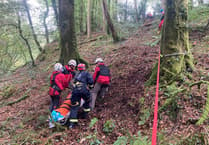
Alec also said that in the most popular areas for ‘adventurers’ such as cavers and climbers, there has been a rapid increase in people getting into trouble because they are inexperienced or untrained. These people are often motivated by so-called TikTok challenges to complete a certain number of climbs, for instance. The drones would be a big help with this workload.
Sgt Chris Linzey, of Devon Cornwall Police drone team, said: “The force works very closely with the search and rescue teams and could not be as effective on search deployments without their specialist skills and local knowledge of the remote terrain. So, it’s to our mutual advantage and to all walkers and users of Dartmoor to have this kit with its advantages.

“We are donating the drones because we have new more advanced models, but the old models have much superior capability to the search and rescue teams’ and we’re training them to make full use of their potential.”
-trains-how-to-use-a-drone-wit.jpeg?trim=168,0,168,0&width=752&height=501&crop=752:501)
Comments
We've recently changed our login process. If you have an account for commenting, you will need to re-register on the login window.
This article has no comments yet. Be the first to leave a comment.